Portfolio Website vs Resume Website: What Do You Really Need?

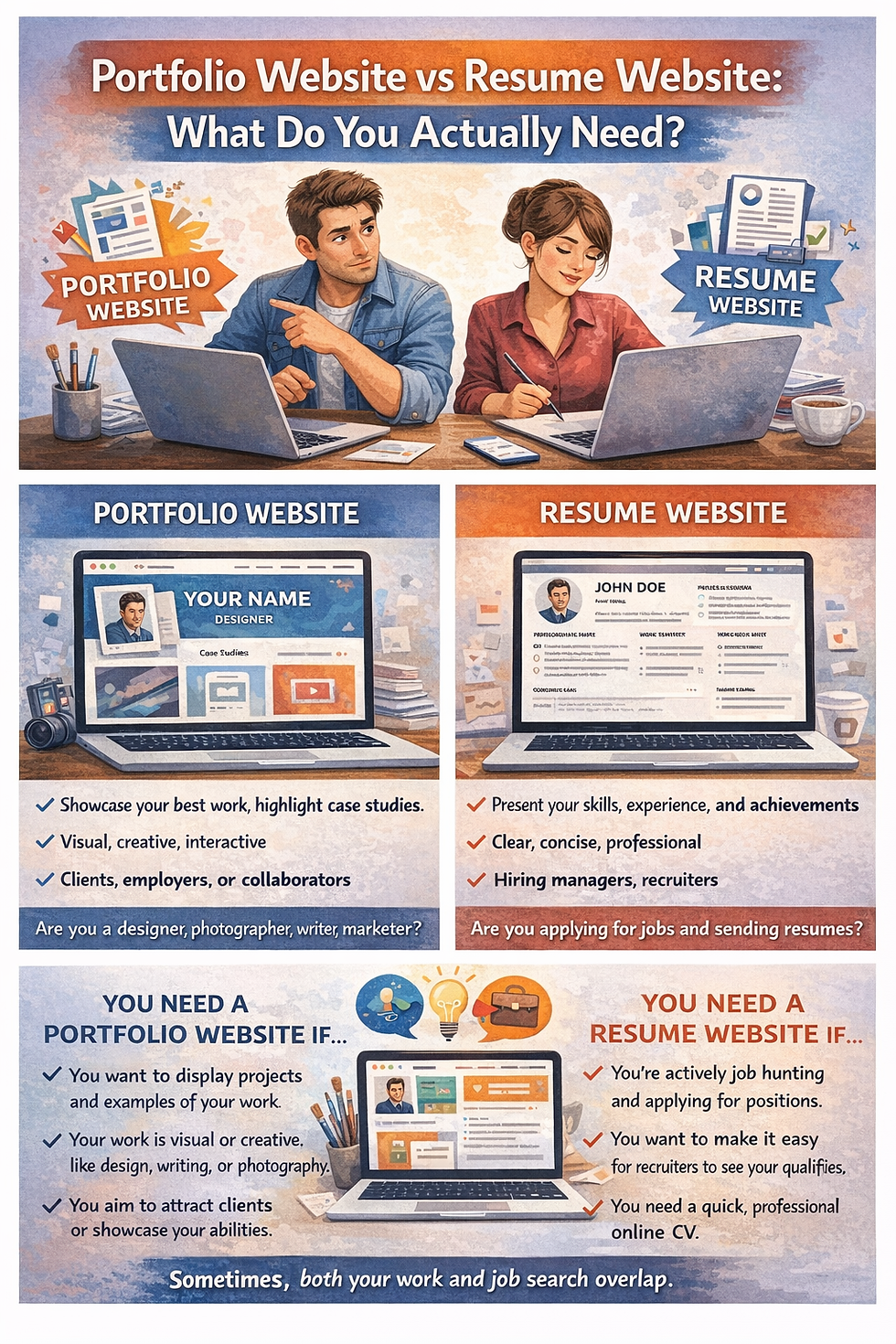
Professionals today are more visible online than ever before. Yet one common question keeps coming up:
“Should I create a portfolio website or a resume website?”
At first glance, the two seem similar. Both present your experience, skills, and background. But in reality, they serve very different purposes, and choosing the wrong one can quietly limit your opportunities.
This article explains the difference clearly — without buzzwords — so you can decide what actually makes sense for your situation.
Understanding the Core Difference
The simplest way to understand the difference is this:
A resume website explains who you are
A portfolio website proves what you can do
Both have value. But they solve different problems.
What Is a Resume Website?
A resume website is a digital version of a CV.
It typically includes:
A professional summary
Work experience
Education
Skills
Certifications
Contact details
The structure is usually linear and chronological, just like a traditional resume.
Who a Resume Website Is Best For
A resume website works well if you are:
Applying for full-time roles
Working with recruiters
Targeting structured hiring processes
Early in your career
Transitioning between roles
In these cases, the website answers one main question:
“Is this person qualified on paper?”
Recruiters often scan dozens of profiles. A resume website helps them quickly verify credentials without downloading documents.
Limitations of a Resume Website
While resume websites are useful, they have limitations:
They rely heavily on titles and timelines
They show what you’ve done, not how you think
They don’t demonstrate problem-solving ability
They offer little insight into real outcomes
For many professionals today, especially those working independently, this is not enough.
What Is a Portfolio Website?
A portfolio website focuses on evidence, not just experience.
Instead of listing roles, it highlights:
Selected projects
Real examples of work
Case studies
Outcomes and results
Process and approach
A portfolio website is not about listing everything you’ve done — it’s about showing relevant proof.
Who a Portfolio Website Is Best For
A portfolio website is ideal if you are:
A freelancer or consultant
A designer, developer, writer, marketer, or strategist
An independent professional
Offering services directly to clients
Selling expertise, not just availability
In this case, the website answers a different question:
“Can this person solve my problem?”
Proof vs Qualification: The Real Difference
This is the most important distinction.
Resume Website | Portfolio Website |
Lists experience | Shows evidence |
Focuses on roles | Focuses on outcomes |
Chronological | Project-based |
Recruiter-friendly | Client-friendly |
Qualification driven | Capability driven |
Clients and hiring managers today care less about long lists of skills and more about:
How you approach problems
How you communicate
Whether your work feels relevant to them
A portfolio website makes this visible.
Why Portfolio Websites Perform Better for Independent Professionals
Independent professionals don’t compete on job titles — they compete on clarity and trust.
A portfolio website helps by:
Reducing the need to explain yourself repeatedly
Pre-qualifying inquiries
Setting expectations early
Filtering out poor-fit leads
Instead of convincing someone verbally, the website does the work quietly.
When a Resume Website Still Makes Sense
A resume website is still the right choice when:
You are actively job-hunting
You want to be searchable by recruiters
Your industry follows formal hiring structures
Your work is difficult to showcase visually or narratively
In these cases, clarity and completeness matter more than persuasion.
The Hybrid Approach (Often the Best Option)
Many professionals benefit from a hybrid approach:
Resume-style clarity for background
Portfolio-style proof for capability
This might look like:
A concise “About” section
Selected work or projects
A short explanation of how you work
Clear contact details
The key is intentional balance, not duplication.
Common Mistake: Turning a Resume Into a Portfolio
One of the most common mistakes is simply pasting resume content into a website.
This creates problems:
Long text blocks
Too much history
No clear narrative
Little differentiation
A portfolio website requires curation, not completeness.
It’s better to show:
2–4 strong projects
Clear context
Your role and decisions
Than to list everything you’ve ever done.
What Clients and Recruiters Actually Look For
Whether someone is hiring you as an employee or a consultant, they are subconsciously asking:
Do I understand what this person does?
Does their work feel relevant to my needs?
Can I trust their judgment?
Is it easy to contact them?
A good portfolio website answers these without effort.
Choosing the Right Option for You
Ask yourself:
Do I want employment opportunities or direct work?
Am I selling availability or expertise?
Do people need proof before trusting me?
Will my work benefit from explanation?
Your answers will usually make the decision obvious.
Final Thought
A website is not just a place to store information. It’s a tool for decision-making.
A resume website helps others decide whether you meet requirements.
A portfolio website helps them decide whether they want to work with you.
The right choice depends on what decision you want your website to support.


Comments